
Battle of Values Self-Storage vs. Flex Space Integration Risks
Small bay 101
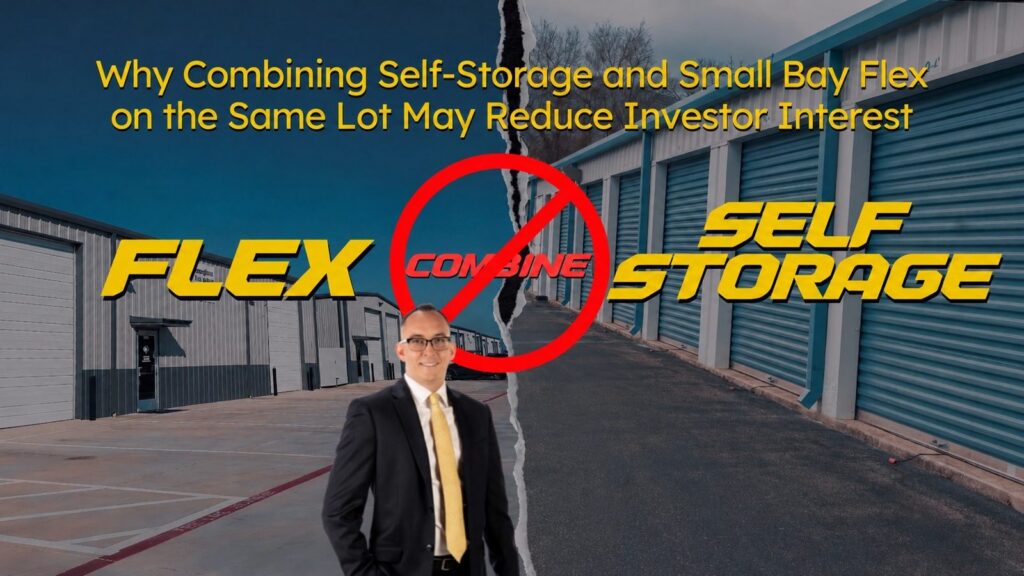
Investing in Flex Space demands careful consideration of market dynamics and investor preferences. One increasingly debated strategy involves combining self-storage facilities with small bay flex spaces on the same property. While this approach may seem efficient from a space utilization standpoint, it can pose not only significant challenges when it comes time to sell but there are numerous examples showing how it can also affect your overall value.
Divergent Investor Preferences and Operational Demands
One of the primary drawbacks is the stark contrast in investor pools that each type of space attracts. Self-storage facilities have a much larger institutional investor database seeking stable, long-term returns from a largely hands-off asset class. In contrast, investors in small bay flex spaces prioritize properties that cater specifically to their operational needs, such as flexible office or light industrial spaces. The management requirements and tenant expectations for each are fundamentally different, influencing their respective investor bases. Self-storage management systems and operations are vastly different to small bay flex management.
Institutional vs. Specialized Investor Appeal
Self-storage is heavily institutionalized, with large funds and institutional investors dominating the market. These investors are drawn to the predictable income streams and scalability of self-storage properties, which align with their portfolio diversification strategies and risk profiles.
“A majority of the buyers for self-storage will only buy self-storage and if it has any flex on the property, it will be an immediate pass.” Says Cody Payne
On the other hand, small bay flex industrial has a larger private sector with a growing fund and institutional side to it with most of them only focusing on collecting small bay flex. Some of the only time we see these asset classes combined is in the private sector when an owner has some extra land and wants to make extra money through diversifying the property. This method can tailor well to the current owner but significantly reduces the buyer pool and overall value when it comes time to sell.
Operational and Management Complexity
The management and operational demands of self-storage facilities differ significantly from those of small bay flex spaces. Self-storage operations require specialized expertise in customer service, security, and facility maintenance tailored to storage unit tenants. In contrast, managing small bay flex spaces involves leasing to a variety of tenants with varying lease terms and operational needs. Small bay flex also continues to be an amenity rich asset class tailoring to specific tenants. There is also a disadvantage when adding storage in since tenants and storage users will be in and out of the property at all times of the day and evening. This can cause security concern for both sides.
Market Perception and Valuation Challenges
The market perception of mixed-use properties combining self-storage and small bay flex can further deter potential buyers. Such properties may be perceived as less specialized or more operationally complex to manage, influencing both valuation and investor interest.
“Let me give you an interesting stat,” says Cody Payne. “We have sold numerous properties that have both self-storage and flex on the same lot, and I can tell you that you lose nearly 80% of your typical buyer pool because they are not interested in this type of hybrid investment.”
Alternative Investment Strategies
In light of these considerations, alternative investment strategies may offer more attractive options for maximizing property value and investor appeal. Exploring separate developments for each type of space or focusing on one specialized use per property could potentially mitigate these challenges and align more closely with investor preferences and market demands.
“It’s not a bad idea to build both storage and flex, but you want to make sure you separately parcel the projects,” Tran advises. “If you are unsure of the demand or which one would be a better investment, feel free to reach out to us, and we can help give you an idea of what the demand in the area looks like.”
In conclusion, while combining self-storage and small bay flex spaces on the same lot may appear beneficial initially, the reduction in investor interest and specialized appeal can outweigh the advantages.