The Amenity Gap: Why Some Small Bay Flex Parks Win and Others Stall
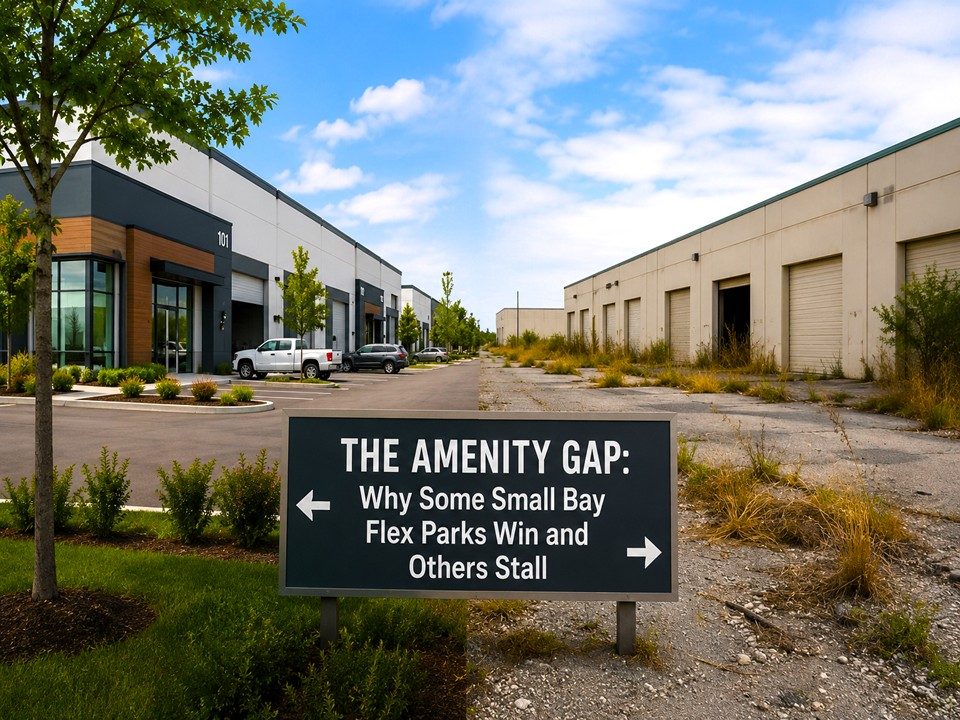
As more investors from self-storage, multifamily, and retail shift into small bay flex industrial, many are entering markets that already have a meaningful base of existing product. While demand for flex space remains strong nationwide, the reality is simple: not all flex space competes equally anymore.
In today’s environment, amenities are no longer optional—they’re the differentiator.
The Shift: From “Build It and They Will Come” to Strategic Positioning
For years, small bay flex industrial was underserved. Developers could deliver basic metal buildings with minimal finish-out and still achieve strong lease-up. That’s no longer the case in many markets.
With over 1,500+ proposed small bay projects across the U.S., new supply is entering markets that already have aging—but functional—inventory (per Small Bay Feasibility). That existing inventory creates competition, even if it lacks modern design.
This is where many new entrants—especially those coming from self-storage—misjudge the opportunity.
“We’re seeing a clear separation in the market—projects with the right amenities are leasing faster and commanding significantly higher rents, while commodity product is getting left behind,” said Cody Payne of Flex Parks USA.
In flex space, tenants have options. And they choose based on usability, functionality, and image—not just price.
Why Market-Specific Amenity Strategy Matters
One of the biggest mistakes new developers make is assuming the same amenity package works everywhere.
In reality, the most successful projects are tailored to the specific tenant base, business density, and competitive landscape of that market.
This is where working with a specialized firm like Small Bay Feasibility becomes critical.
Firms that focus exclusively on small bay industrial can identify:
-
Which amenities are actually in demand in that submarket
-
Which features will drive faster lease-up
-
And which upgrades can justify meaningfully higher rental rates
Without that level of insight, developers often overbuild in the wrong areas—or worse, underbuild in markets where tenants are willing to pay a premium.
Why Amenities Matter More in Competitive Flex Markets
When a market has a large share of existing flex inventory, tenants are already familiar with the product type. That means your project isn’t introducing a new concept—it’s competing head-to-head.
Amenities give you the edge in three critical ways:
1. Higher Rents
Well-designed parks with the right amenities can command 15–30%+ rent premiums over older, functionally obsolete properties, based on data from Small Bay Feasibility.
Tenants will pay more for features that directly impact their business operations—especially when those features drive revenue or efficiency.
2. Faster Lease-Up
Modern amenities reduce friction in the leasing process. Prospective tenants don’t need to “imagine” how the space works—it already fits their needs.
This is especially important in markets where new construction is being delivered without pre-leasing.
3. Stronger Tenant Retention
Flex tenants often operate growing businesses. If your property supports that growth, they stay. If it doesn’t, they leave.
Amenities create stickiness—and stickiness drives long-term value.
The Amenities That Actually Move the Needle
Not all amenities create real value. The top-performing small bay flex parks focus on features that directly impact tenant operations, visibility, and scalability.
Rear or Side Fenced Storage Yards
This is one of the most important—and most underbuilt—amenities in small bay flex.
Secured outdoor storage allows tenants to store equipment, vehicles, trailers, and materials directly adjacent to their unit. For contractors, service businesses, and equipment-heavy users, this is not a luxury—it’s a requirement.
Properties that incorporate fenced yards consistently:
-
Achieve higher rents
-
Maintain stronger occupancy
-
Attract higher-quality, longer-term tenants
In many cases, this single amenity is the difference between an average deal and a top-performing asset.
Monument Signage & Tenant Visibility
Signage is often overlooked, but it plays a major role in tenant demand.
Flex tenants rely heavily on local visibility to generate business. Clean, professional monument signage at the entrance—and clear unit visibility within the park—adds real value to tenants.
It also elevates the perception of the entire project, helping attract a broader tenant base beyond traditional industrial users.
Additional Parking & Functional Site Design
One of the most common mistakes in new development is underestimating parking needs.
Modern flex tenants—especially e-commerce, showroom, and service-based businesses—often require more parking than traditional industrial users.
Additional parking:
-
Expands your potential tenant pool
-
Reduces operational friction for tenants
-
Improves long-term lease stability
Combined with proper circulation and access, strong site design ensures the property functions efficiently for a wide range of users.
Clear Height
Clear height has become one of the most important functional specs in modern small bay flex. Older inventory often tops out at 12–14 feet, which limits the types of tenants you can serve and the equipment they can operate.
Top-performing projects deliver clear heights of 18 feet or more. That added height opens the door to a much broader tenant base—light manufacturing, e-commerce with racking, sports and recreation users, and equipment-heavy service businesses—all of which are willing to pay premium rents for space that actually works for their operations.
In competitive markets, anything under 18 feet starts to feel dated—and tenants notice.
Glass Storefronts
Glass storefronts on the front elevation are one of the highest-impact amenities for the cost. They instantly elevate the look of a project, signal a higher-quality tenant base, and create real value for businesses that depend on customer-facing visibility.
Showroom users, hybrid retail tenants, fitness and recreation concepts, and service businesses with walk-in clientele all gravitate toward units with glass fronts. These tenants typically pay higher rents and stay longer—both of which directly drive asset value.
Even for traditional industrial and contractor tenants, glass fronts improve natural light and overall unit appeal, making the entire park feel more modern and professional.
A Key Mistake: Underbuilding in Competitive Markets
Many developers entering from self-storage are accustomed to a model where simplicity and cost efficiency drive returns.
While that approach works in certain flex markets—especially rural or underserved areas—it can backfire in competitive environments.
Building an “efficient” park in a market filled with existing flex space often positions your asset as just another option—not the best option.
And in today’s market, the best option wins.
Designing for the Modern Flex Tenant
The tenant profile in small bay flex has evolved. It’s no longer just contractors and trades.
Today’s tenant mix includes:
-
E-commerce and last-mile distribution users
-
Sports and recreation businesses
-
Showroom and hybrid retail users
-
Light manufacturing and assembly
-
Service-based businesses with operational space needs
These tenants prioritize functionality, flexibility, and image—all of which are influenced by amenities.
The Bottom Line
For investors and developers entering small bay flex industrial—especially from other asset classes—the playbook needs to evolve.
In markets with existing inventory, success is no longer about simply delivering space.
It’s about delivering better space.
Amenities are what separate average projects from top-performing assets. They drive rent, accelerate lease-up, and create long-term tenant demand.
And as more capital flows into the sector, that gap between commodity and premium product will only continue to widen.